A Little Give by Marina Benjamin
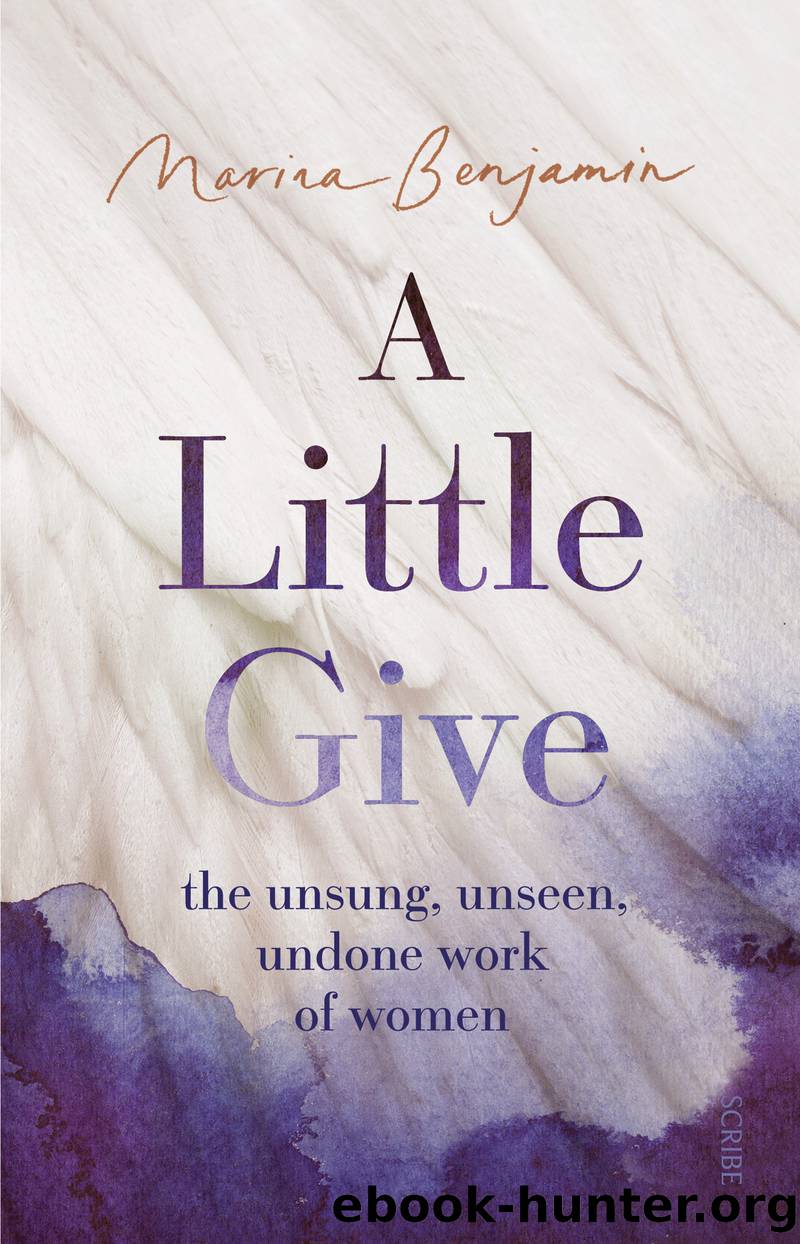
Author:Marina Benjamin
Language: eng
Format: epub
Tags: BIO026000, BIO022000, SOC010000, SOC032000, SOC028000, FAM000000, SOC026010
Publisher: Scribe Publications Pty Ltd
Published: 2023-01-31T00:00:00+00:00
More than anyone, I know that there is no virtue in the care I offer my mother. Every time I fail to conceal my annoyance at her slowness or bristle at a thrice-repeated question I am cognisant of how far I fall short of selflessness. It is one thing to tamp down the naggings of ego, setting your own aspirations and desires to one side on behalf of a loved one. But this temporary muffling of the self falls far short of its transcendence, a kind of liberation that Iris Murdoch seems to have been reaching for with the concept of âunselfingâ.
Murdoch touches on this idea all too briefly in The Sovereignty of Good (1970), taking an example drawn from nature. She talks about being in an âanxious and resentful state of mindâ and then looking out of the window and catching sight of a âhovering kestrelâ. The sheer beauty of the bird, wings outstretched, effortlessly suspended, lifts her out of herself. It fills her mind. Leaves her exalted. âIn a moment everything is altered. The brooding self with its hurt vanity has disappeared. There is nothing now but kestrel.â For a brief moment the self is so porous it is subject to external override, a torrent of joy washing away the cloudy internal weather.
I struggle to find moments of joyful unselfing in the drudgery of daily care, though now and then I manage to absent myself from the task in hand and float away from my own concerns. If I wanted to dignify the experience I might invoke the Christian concept of kenosis, a kind of self-emptying that takes place not so that one can fill up the tank again with some higher thing, but so that one becomes transparent like a window or a ghost. You are functionally present and yet somehow profoundly absent.
But I do not particularly want to dignify my labours, which are more self-obliterating than transformative: I have to flatten myself into a two-dimensional being and rub off all my corners in order to be with my mother these days. And I am no saint. More and more I resent being her backstop.
A loving friend who eventually committed her own mother to a care home has been looking out for me. âThis is only going one wayâ, she said recently, âand if you keep stepping in to cover for her trip-ups and failures sheâll end up eating you aliveâ.
The slide into self-oblivion happens by imperceptible degrees. That is what makes it so dangerous. The small ministrations, the constant vigilance, the endless availability easily slip from view, becoming part of the taken-for-granted fabric of things. This care slips under the radar because its aims are modest. Because it seeks merely to keep everything the same. The philosopher Ivan Illich was right in pointing the finger at care work as a chief example of the blunt end of the industrial economy: neglected, exploitative, largely non-monetised and incrementally âselfâ eroding, he called it âshadow workâ.
I have so well disguised my own labour that even my mother, its chief beneficiary, cannot see it.
Download
This site does not store any files on its server. We only index and link to content provided by other sites. Please contact the content providers to delete copyright contents if any and email us, we'll remove relevant links or contents immediately.
| Anthropology | Archaeology |
| Philosophy | Politics & Government |
| Social Sciences | Sociology |
| Women's Studies |
Cecilia; Or, Memoirs of an Heiress — Volume 1 by Fanny Burney(32558)
The Great Music City by Andrea Baker(32019)
Cecilia; Or, Memoirs of an Heiress — Volume 2 by Fanny Burney(31956)
Cecilia; Or, Memoirs of an Heiress — Volume 3 by Fanny Burney(31942)
We're Going to Need More Wine by Gabrielle Union(19046)
All the Missing Girls by Megan Miranda(16029)
Pimp by Iceberg Slim(14508)
For the Love of Europe by Rick Steves(14121)
Bombshells: Glamour Girls of a Lifetime by Sullivan Steve(14076)
Talking to Strangers by Malcolm Gladwell(13370)
Norse Mythology by Gaiman Neil(13366)
Fifty Shades Freed by E L James(13243)
Mindhunter: Inside the FBI's Elite Serial Crime Unit by John E. Douglas & Mark Olshaker(9344)
Crazy Rich Asians by Kevin Kwan(9292)
The Lost Art of Listening by Michael P. Nichols(7506)
Enlightenment Now: The Case for Reason, Science, Humanism, and Progress by Steven Pinker(7314)
The Four Agreements by Don Miguel Ruiz(6765)
Bad Blood by John Carreyrou(6622)
Weapons of Math Destruction by Cathy O'Neil(6281)
